

Canadian boarding schools
Dernière mise à jour : 28 nov. 2025
Written by Néïs Demellier. Rédigé par Néïs Demellier.
This story can be triggering to some readers. The following Canadian telephone lines are available 24 hours a day for those in need of support. Cette histoire peut provoquer des réactions post-traumatiques pour certain⸱e⸱s lecteur⸱ices⸱s. Les lignes téléphoniques canadiennes ci-dessous sont joignables 24h/24 pour celles et ceux dans le besoin.
National Centre for Truth and Reconciliation (NCTR) Residential School Crisis Line: 1 866 925 4419
Indian Residential School Survivors Society (IRSSS) Emergency Crisis Line: 1 800 721 0066
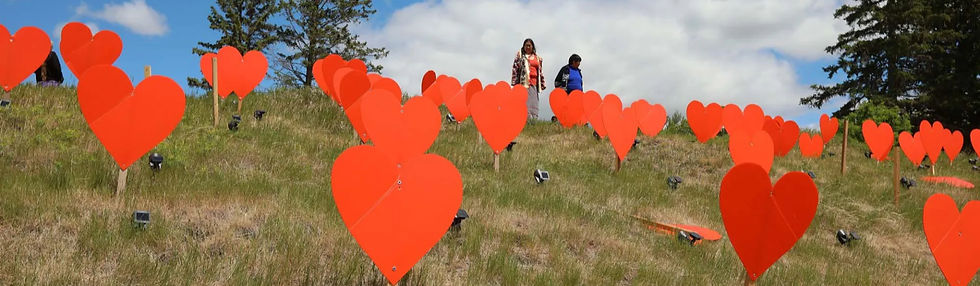
The hearts, children's shoes, and stuffed toys you see on the map are those used by the Indigenous communities — whose elders and ancestors went through the Indigenous boarding schools — to commemorate the lives of those who died there, killed by the colonial system. Les cœurs, chaussures et peluches pour enfants que vous voyez sur la carte sont celles et ceux utilisés par les communautés autochtones — dont les aîné⸱e⸱s et les ancêtres ont vécu les pensionnats autochtones — pour commémorer la vie de celles et ceux qui y sont mort⸱e⸱s, tué⸱e⸱s par le système colonial.


date: 1831-1997
Contextualization: the Indigenous Boarding Schools
Indigenous boarding schools – also called Indian residential schools – have their origins in the evangelistic missions led by the first European settlers in America, which advocated the superiority of white Christian culture over Native American ones. As soon as the early 1800s, settlers identified the children as the key to assimilation of Indigenous people. To achieve this, they opened many boarding schools, more or less directly under the Church supervision, in which children torn away from their communities were housed in order to be ‘converted’ to white culture. This goal, and the means used to fulfill it, have been clearly enounced by the Canadian Government. In 1879, Canadian Prime Minister John A. Macdonald states that “Indian children should be withdrawn as much as possible from the parental influence” in order to “take the Indian out of the child”. Mohawk Indian Residential School (Brantford, Ontario) was the first to open, in 1831, and Kivalliq Hall (Rankin Inlet, Nunavut), the last one in use and recognized as such, closed in 1997 (NCTR: Residential School Timeline ; Nunavut Tunngavik: Kivalliq Hall ; Whiting 2024:405-406).
It is difficult to estimate the exact number of Indigenous boarding schools in Canada, as well as the number of children who attended them. In 2007, the Indian Residential Schools Settlement Agreement (IRSSA) estimate that there have been 139 residential schools in Canada, but this number kept growing ever since (Whiting 2024:406). Kivalliq Hall, for example, have been officially recognized as an Indigenous boarding school only in 2019. To this day, at least 62 sites not recognized by the IRSSA are investigated in order to acknowledge the role they played within the Canadian residential school system (Canadian Geographic: Path to Reconciliation). Here we speak only of Canada, but it is important to remember that Indigenous boarding schools also existed in the United States – where in 2020 the Native American Boarding School Healing Coalition (NABS) estimates their total number to be of 367 (Montgomery and Supernant 2022) – and, to a lesser degree, in Mexico (Dawson 2012).
Estimations state that around 150,000 children have been through these institutions (Miller 2012: online), but this number predates the recent reevaluations of the total number of residential schools. The Canadian Truth and Reconciliation Commission (TRC), in its 2015 final report (2015a, pages 90 to 99), counts 3,201 deaths that have been reported to the Canadian Government by the residential schools. Same year as the report’s publication, TCR chairman Mizhana Gheezhik (Murray Sinclair) says in an interview that “we have not uncovered anywhere near where the total would be because the record keeping around that question was very poor”. He explains that around 24% to 42% of the children interned died in the school, or quickly after they left. These deaths were caused by poor living conditions in the residential schools, the lack of healthcare, violence and neglect. Some children committed suicide and others got lost when trying to escape.
This cultural genocide lasted for two centuries and the last recognized boarding school closed less than 30 years ago. These institutions and practices has had and keep on having a huge impact on Indigenous people, on the survivors of these schools and on the communities from which the victims came. The Canadian Truth and Reconciliation Commission is mandated to inform all Canadians about this past. With our project, we want to help raise awareness and recognition of this residential school system here in Europe. We think that European nations must, and have to, remember and acknowledge the colonial violence perpetrated upon native communities within the colonies they administrated. That said, we would like to point out one more time that Indigenous boarding schools predate the creation of the Canadian state. Finally, these north American residential schools systems are reminiscent of those established by Norway, Sweden and Finland to assimilate the Saami Indigenous people (Inga Rebecca Partida : online).
Contextualisation : les pensionnats autochtones
Les pensionnats autochtones prennent racine dans les missions évangélisatrices menées par les premiers colons européens en Amérique, qui prônent une supériorité de la culture chrétienne blanche sur les cultures natives américaines. Dès le début des années 1800, les colons identifient les enfants comme des éléments-clefs pour l’assimilation des populations autochtones. Ainsi, ils ouvrent plusieurs pensionnats, plus ou moins directement gérés par l’Eglise, destinés à accueillir des enfants arrachés à leur communauté pour les « convertir » à la culture blanche. Cet objectif, et les moyens mis en œuvre pour y parvenir, sont clairement énoncés par le gouvernement canadien. En 1879, le Premier Ministre Canadien John A. Macdonald déclare que « les enfants indiens doivent être éloignés autant que possible de l’influence parentale » afin de « faire sortir l’indien de l’enfant ». Le pensionnat autochtone de l’Institut Mohawk (Brantford, Ontario) est le premier à avoir ouvert, en 1831, et Kivalliq Hall (Rankin Inlet, Nunavut), le dernier pensionnat officiellement reconnu comme tel à avoir fermé, en 1997 (NCTR : Residential School Timeline ; Nunavut Tunngavik : Kivalliq Hall ; Whiting 2024 : 405‑406).
Il est difficile d’estimer le nombre exact de pensionnats autochtones et d’enfants victimes de ces derniers au Canada. En 2007, l’Indian Residential Schools Settlement Agreement (IRSSA) en compte 139, mais ce nombre a depuis grandi (Whiting 2024 : 406). Le pensionnat de Kivalliq Hall n’a, par exemple, été officiellement reconnu comme pensionnat autochtone qu’en 2019. Au moins 62 sites non reconnus par l’IRSSA à ce jour font l’objet de recherches visant à documenter leur rôle au sein du système canadien de pensionnats autochtones (Canadian Geographic : Path to Reconciliation). Si l’on ne parle ici que du Canada, des pensionnats autochtones ont aussi existé aux Etats-Unis, où la Native American Boarding School Healing Coalition (NABS) en dénombre 367 en 2020 (Montgomery et Supernant 2022), et, dans une moindre mesure, au Mexique (Dawson 2012).
Au Canada, on estime généralement que 150 000 enfants seraient passés par ces pensionnats (Miller 2012 : en ligne), bien que cette estimation prédate la réévaluation du nombre de pensionnats mentionnée plus haut. La Commission de vérité et de réconciliation du Canada (TCR), dans son rapport final de 2015 (2015a, pages 90-99), décompte 3201 décès d’enfants ayant été rapportés par les pensionnats au gouvernement canadien. L’année de la publication de ce rapport, le président de la TCR Mizhana Gheezhik (Murray Sinclair) affirme dans une interview que « nous sommes loin d’avoir découvert le montant total car les registres relatifs à cette question étaient très incomplets » (traduction libre). Il explique qu’entre 24% et 42% des enfants mourraient dans les pensionnats ou rapidement après leur sortie. Ces décès sont associés aux mauvaises conditions de vie dans les internats, au manque de soins, à la violence et à la négligence. Certains enfants se sont suicidés et d’autres ont disparu en tentant de s’enfuir.
Ce génocide culturel a duré près de deux siècles et le dernier pensionnat reconnu comme tel à ce jour a fermé il y a moins de 30 ans. Ces pratiques et institutions ont eu et ont toujours un impact immense sur les populations autochtones, les survivants de ces internats et les communautés desquelles viennent les victimes. Le Comité de la vérité et de la réconciliation a pour mission d’informer les Canadiens sur ce passé. A travers ce projet cartographique, nous souhaitons participer à faire connaître et reconnaître ce système de pensionnats autochtones en Europe. Nous pensons que les nations européennes doivent, elles aussi, se rappeler de la violence coloniale exercée sur les communautés natives dans les colonies qu’elles administraient. Nous rappelons à ce titre que les pensionnats autochtones prédatent la création de l’Etat canadien. Enfin, les pensionnats nord-américains ne sont pas sans rappeler ceux mis en place par la Norvège, la Suède et la Finlande pour assimiler les groupes autochtones Saami (Inga Rebecca Partida : en ligne).
Archaeology and Missing Graves
Recently, several project have been developed in order to identify and document the position and number of graves associated with the Canadian Indigenous boarding schools. These projects, led by the Indigenous communities, consists in leading geophysical surveys – mostly ground penetrating radar (GPR). Geophysical surveys, which are already well known in the archaeology field, allow for the detection of underground structures without excavating. This approach allows for the localization, delimitation and protection of the graves without digging them. These projects also require searching through written archives, old maps and pictures as well as interviewing the boarding schools survivors (Whiting 2024:408, 410).
One of the firsts projects of this sort was established on the site of the Brandon Indian Residential School (BIRS), southwestern Manitoba. In the late 1990s, parents from a northern Cree community contacted the Manitoba Historic Resource Branch archaeologist. They wanted to know the localization of their daughter, who died while attending the BIRS. Their request, because of the poor documentation of the residential schools deaths, did not lead anywhere (Nichols 2015:1-4). Between 2010 and 2015, archaeologist Katherine Nichols (at the time a Master’s student at the University of Manitoba) developed a research project aiming to localize the BIRS missing graves, as well as assessing the number and names of the children who died there. This project was established in close collaboration with Chief and Elder from the Sioux Valley Dakota Nation, on whose territory are the BIRS ruins. The objectives, ins and outs of the project were established according to the demands and needs of the Sioux Valley Dakota Nation members (Nichols 2015:9).
In its 2015 final report, the Truth and Reconciliation Commission of Canada listed 94 calls for action (Truth and Reconciliation Commission 2015b), including recommendations regarding the documentation and commemoration of dead and missing children. Researches keep on going at BIRS, within the Brandon Indian Residential School Cemeteries Project, and others similar projects have been established in several locations (see, for example the GPR surveys carried out by Kisha Supernant, Institute of Prairie and Indigenous Archaeology).
In 2021, Tk’emlúps te Secwépemc First Nation – on which land is located the ancient Indigenous residential school of Kamloops – announced that 215 missing graves have been discovered during GPR surveys (Tk’emlúps te Secwépemc 2021 : online). This announcement received significant media coverage, actually shocking many non-native Canadians. Such a media outburst led to several instances of misinformation (largely due to a lack of understanding regarding the capabilities and limitations of GPR surveys), denial of the violences perpetrated in the residential schools, and even questioning the validity of the Tk’emlúps te Secwépemc Nation’s declaration (Gerbrandt et Carleton 2023). These reactions highlight the importance of documenting this past, and of commemorating the victims of residential schools: it is in the ignorance, indifference, and racism of non-Indigenous people that these reactions to the discoveries made in Kamloops take hold.
Since archaeology seeks to document the past, it is part of its duty to help shed light on the history of Indigenous residential schools, especially where the study of written archives is far from enough. In that regard, we will quote the last paragraph of Katerine Nichols’s Master’s thesis:
“While it seems that many people in Brandon do not know about the BIRS, the lingering effects of the school continue to ripple within the community today. For the parents who were unable to bring their daughter’s remains home, their lives will never be the same again. This is also true for the 70 families representing 13 different First Nation communities in Manitoba whose children never returned home. And so, if we can begin to accurately look at the tragedy in our own backyard, we might begin to courageously look at our past and confront our history in order to speak the truth about what happened at the BIRS. [...] This is one way we might work together to build strong alliances, and be capable of authentically continuing the process of truth and reconciliation in Canada.” (Nichols 2015:162-163)
Le rôle de l'archéologie
Depuis quelques années, plusieurs projets se sont développés pour identifier et documenter la position et le nombre de sépultures associées aux pensionnats autochtones canadiens. Ces projets, initiés par les communautés natives, consistent en la mise en place de prospections géophysiques – le plus souvent par radar à pénétration de sol. Les prospections géophysiques, déjà bien connues en archéologie, permettent de détecter des structures souterraines sans ouvrir de fouilles. Cette approche permet donc de localiser, délimiter et protéger les sépultures sans les excaver. En plus de ces prospections, les projets menés sur les anciens pensionnats reposent sur l’étude des archives (registres, cartes, photographies) et des entretiens avec les survivants (Whiting 2024 : 408, 410).
L’un des premiers projets de ce type a été mis en place sur le site de l’ancien pensionnat de Brandon, dans le sud-ouest du Manitoba. A la fin des années 1990, des parents d’une communauté Crie du nord du Manitoba contactent l’archéologue affilié au gouvernement de la province. Ils demandent à connaître la localisation du corps de leur fille, morte alors qu’elle était au pensionnat de Brandon. Leur demande, du fait des importantes lacunes dans les registres de l’époque, n’a pas abouti (Nichols 2015 : 1-4). Entre 2010 et 2015, l’archéologue Katherine Nichols (alors étudiante de Master à l’Université de Manitoba) met au point un projet de recherche visant à localiser les sépultures du pensionnat de Brandon et à documenter le nombre et le nom des enfants décédés. Pour ce faire, elle collabore avec la Nation Dakota de Sioux Valley, sur le territoire desquels se trouvent les ruines de l’ancien pensionnat. Les objectifs, tenants et aboutissants de ce projet ont été établis d’après les demandes et les besoins des membres de la Nation Dakota de Sioux Valley (Nichols 2015 : 9).
Dans son rapport final de 2015, la Commission pour la vérité et la réconciliation au Canada liste 94 appels à l'action (Truth and Reconciliation Commission 2015b), dont plusieurs recommandations relatives à la collecte d’information et à la commémoration des enfants morts et disparus. Les recherches se poursuivent sur le site de BIRS, dans le cadre du Brandon Indian Residential School Cemeteries Project, et d’autres projets similaires se sont développés sur d’autres pensionnats autochtones (voir par exemple les prospections géophysiques réalisées par Kisha Supernant, de l’Institute of Prairie and Indigenous Archaeology).
En 2021, la Nation Tk’emlúps te Secwépemc, sur le territoire de laquelle se trouve l’ancien pensionnat autochtone de Kamloops, annonce la découverte de 215 sépultures associées au pensionnat suite à des prospections géoradar (Tk’emlúps te Secwépemc 2021 : en ligne). Cette annonce a eu un retentissement médiatique important, choquant un grand nombre de canadiens non-natifs. De cet engouement médiatique ont découlé plusieurs phénomènes de désinformation (portées notamment par une incompréhension vis-à-vis des possibilités et limites du géoradar), un négationnisme vis-à-vis des violences exercées dans les pensionnats autochtones et la remise en question du bienfondé de la déclaration de la Nation Tk’emlúps te Secwépemc (Gerbrandt et Carleton 2023). Ces réactions mettent en lumière l’importance qu’il y a à documenter ce passé et commémorer les victimes des pensionnats autochtones : c’est dans l’ignorance, l’indifférence et le racisme des non-autochtones que prennent racine ces réactions face aux découvertes faites à Kamloops.
Si l’archéologie cherche à documenter le passé, alors il est de son devoir de participer à mettre en lumière l’histoire des pensionnats autochtones, notamment là où l’étude des archives écrites est loin d’être suffisante. A ce titre, nous citerons le dernier paragraphe du mémoire de Katherine Nichols :
« Alors que beaucoup de gens à Brandon semblent ignorer l’existence du pensionnat autochtone, les répercussions de son existence continuent à avoir des conséquences sur le quotidien des membres de la communauté. Pour les parents qui n’ont pas pu ramener chez eux la dépouille de leur fille, la vie ne sera plus jamais la même. C’est aussi vrai pour les 70 familles, issues de 13 communautés autochtones différentes du Manitoba, dont les enfants ne sont jamais rentrés. Ainsi, si nous pouvons commencer à réellement s'intéresser à la tragédie qui s’est déroulée sous nos yeux, nous pourrons peut-être commencer à faire face à notre passé et affronter notre histoire afin de dire la vérité sur ce qu’il s’est passé au pensionnat. […] C’est une voie que nous pourrions emprunter pour travailler ensemble à la création d’alliances solides et être en mesure de poursuivre de manière authentique le processus de vérité et de réconciliation au Canada. » (Nichols 2015:162-163 ; traduction libre)

SOURCES :
Dawson, Alexander S. 2012. Histories and Memories of the Indian Boarding Schools in Mexico, Canada, and the United States. Latin American Perspectives, Vol. 39(5), 80‑99.
Canadian Geographic. 2023. Unmarked Graves and Burial Sites Associated with Indian Residential Schools. Path to Reconciliation.
CBC News. 2015. Justice Murray Sinclair Interview, 30 Mai 2015.
Gerbrandt, Reid, & Sean Carleton. 2023. Debunking the “Mass Grave Hoax” : A Report on Media Coverage and Residential School Denialism in Canada. Centre for Human Rights Research, University of Manitoba.
Inga, Rebecca Partida. [online]. Suffering Through the Education System : The Sami Boarding Schools. Dieda: History. Sami Culture. University of Texas website.
Miller, J. R. 2012. Residential schools in Canada. Updated in January, 2024 by Tabitha De Bruin, David Gallant and Michelle Filice. The Canadian Encyclopedia.
Montgomery, Lindsay M., & Kisha Supernant. 2022. Archaeology in 2021 : Repatriation, reclamation, and reckoning with historical trauma. American Anthropologist, Vol. 124(4), 800‑812.
Nichols, Katherine L. 2015. Investigation of unmarked graves and burial grounds at the Brandon Indian Residential School , Master's Thesis, University of Manitoba.
National Centre for Truth and Reconciliation Center. [online]. Residential School Timeline.
Nunavut Tunngavik. 2019. Kivalliq Hall Recognized as a Residential School.
Simon Fraser University. [online]. Brandon Indian Residential School Cemeteries Project.
Tk’emlúps te Secwépemc. 2021. Remains of Children of Kamloops Residential School Discovered. Tk’emlúps Te Secwépemc.
Truth and Reconciliation Commission of Canada. 2015a. Honouring the Truth, Reconciling for the Future Summary of the Final Report of the Truth and Reconciliation Commission of Canada. Library and Archives Canada Cataloguing in Publication.
Truth and Reconciliation Commission of Canada. 2015b. Truth and Reconciliation Commission of Canada: Calls to Action. Winnipeg, Manitoba.
University of Alberta. [online]. Remote Sensing and Burial Ground Research, Institute of Prairie and Indigenous Archaeology.
Whiting, Brian. 2024. Community-led investigations of unmarked graves at Indian residential schools in Western Canada—Overview, status report and best practices. Archaeological Prospection, Vol. 31(4), 403‑418.
TO GO FURTHER / POUR ALLER PLUS LOIN /
Al Jazeera English. 2017. Canada's Dark Secret. Featured Documentaries.
Bombay, Amy, Kimberly Matheson, & Hymie Anisman. 2014. The intergenerational effects of Indian Residential Schools : Implications for the concept of historical trauma. Transcultural Psychiatry, Vol. 51(3), 320‑338.
Simons, Eric, & Katherine L. Nichols. 2021. Archaeology’s Role in Finding Missing Indigenous Children in Canada. SAPIENS.
Xue Luo, Carina. 2024. Missing Children of Indian Residential Schools. On discovery of unmarked graves at former Indian residential school sites in Canada. ArcGIS StoryMaps.


